
The Patient
Recently, a relative shared their experience. They had been tracking symptoms for months, finally secured a hard-to-get specialist appointment, and arrived hopeful. From the start, the visit went wrong.
When they began explaining their symptoms, the physician glanced at their watch, seemed to make up their mind almost immediately, ordered a battery of blood tests, and left the room without asking deeper questions. Before the patient could even finish sharing, the encounter was over.
The deeper sting came at the front desk. When this young patient asked, “What are these tests for?” the receptionist curtly replied, “If I told you, would you even know?”
That dismissive answer only compounded their apprehension. This was not a patient questioning whether the tests were necessary. This was a patient asking, as so many do today, “Can I afford this, will my insurance even cover it?” And even beyond the financial worry, patients have a right to know why specific tests are being ordered and how those tests connect to the symptoms they presented in the first place. To be brushed off in that moment, whether from ignorance or burnout, was not only unprofessional, it was dehumanizing.
For a young person already hesitant to seek medical care, to gather the courage to see a physician, and not just any physician but a specialist, only to be dismissed and treated this way, was disheartening. Instead of leaving with clarity or reassurance, they left feeling smaller, unheard, and less likely to return.
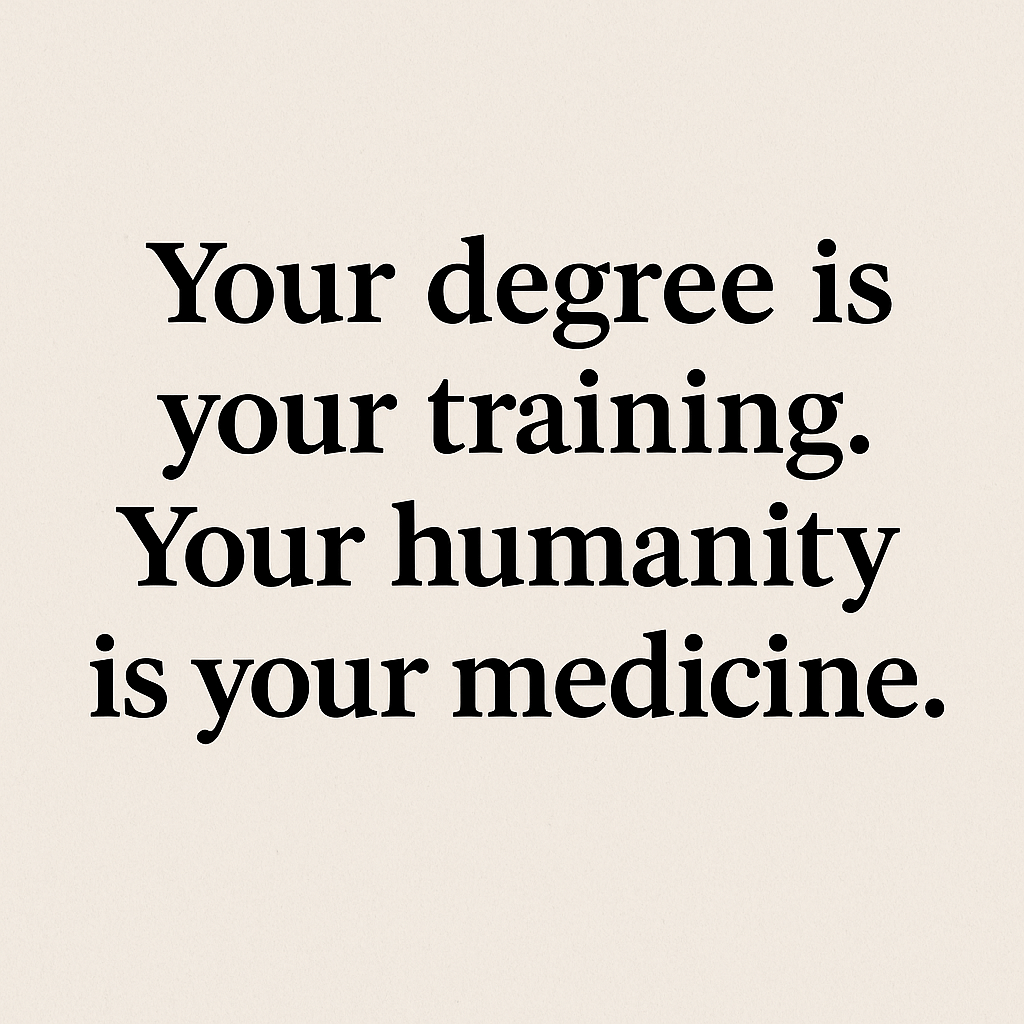
Your Degree Is Your Training. Your Humanity Is Your Medicine.
Most practitioners begin this journey with a deep why, to help, to heal, to serve. Yet the system grinds us down.
Administrative overload cuts 30 minute visits into 10, Insurance dictates care and pace, Burnout from endless quotas and staffing shortages and Patients arrive already armed with “Dr. Google” or AI searches, convinced of their own diagnosis before the conversation begins
Access to information is valuable, but no search engine replaces years of education, practice, and judgment. For many practitioners, this new layer of expectation makes an already strained encounter harder.
The Mutual Objectification
Patients begin to see practitioners as service machines.
Practitioners begin to see patients as charts or numbers.
And in that exchange, humanity is lost.
The white coat can be deceiving. It makes us expect perfection, instant clarity, and superhuman answers. But here is what we often forget: ALL practitioners are human beings too. They have families and childcare challenges, they care for aging parents, they wrestle with their own illnesses and mental health, and they shoulder bills and expenses like everyone else. They have marriages that fail, they go through divorce, and they live with financial stresses and strains. It may be hard to believe when you are sitting in a waiting room, but the truth is they carry many of the same life struggles we do. Remembering this softens the encounter because when both sides see each other’s humanity, something shifts.
Expectations on Both Sides
There are expectations on both sides. Patients walk in hoping for more time, more listening, more answers. Practitioners walk in hoping for clarity, honesty, and cooperation. Sometimes, on both sides, the expectations are unreasonable. When we let those expectations collide unchecked, frustration replaces connection.
The Bigger Issue
This is a symptom of a larger system that undervalues empathy and rewards speed over presence. Insurance bureaucracy, drug regulation, opioid crises, physician shortages, none of these are disappearing soon. But while we wait for systemic reform, we cannot abandon the one medicine always available, human connection.
Let’s remember our why. This is not only for physicians, psychologists, dentists, or educators it is for me too. I am a practitioner, and I know how easy it is to lose sight of the reason we began.
Your degree is your training. Your humanity is your medicine.
If we can return to that truth ,seeing each patient, each client, each student as a person, and remembering that we ourselves are people first , then care can be restored.
Healing begins when we stop objectifying one another and start listening again.
“I will remember that there is art to medicine as well as science, and that warmth, sympathy, and understanding may outweigh the surgeon’s knife or the chemist’s drug.” — from the Hippocratic Oath
 Quackenbush Coaching LLC