
For decades, retirement was framed as the finish line. Work hard, endure the grind, collect the pension, and finally rest.
But today, that model is obsolete.
People are living longer, healthier lives. Many retire with decades of vitality still ahead. Yet one of the greatest emotional risks during retirement is not financial uncertainty. It is loss of identity, structure, and belonging.
I often tell my clients:
You don’t retire FROM something.
You retire TO something.
Because when you leave a career, you are not only leaving a paycheck. You are leaving:
- daily routines
- trusted relationships
- a sense of relevance
- intellectual stimulation
- a place where your contributions mattered
Without intentional planning, this sudden vacuum can lead to loneliness, depression, cognitive decline, and a loss of purpose.
Research from the National Institute on Aging and the Harvard Study of Adult Development confirms that social connection, purpose, and routine are among the strongest predictors of longevity and wellbeing.
Retirement is not the end of usefulness.
It is the beginning of reinvention.
And that reinvention should begin before your final day of work.
Why Retirement Can Feel So Disorienting
Even positive transitions create stress.
When people retire after 20, 30, or 40 years in the same field, they experience:
Identity disruption
Who am I if I’m not the director, the nurse, the teacher, the executive?
Loss of social structure
Work relationships often provide daily connection and belonging.
Routine collapse
Our brains thrive on rhythm and predictability.
Cognitive under stimulation
Mental engagement drops sharply without intentional activity.
Emotional vulnerability
Loneliness and depression rates increase when connection decreases.
Retirement without purpose is not rest.
It is disorientation.
The Myth of Permanent Vacation
Many people envision retirement as an extended season of rest.
I’ll travel.
I’ll go fishing.
I’ll finally relax.
I’ll do whatever I want.
And for a while, that freedom feels wonderful.
The first months often bring relief, joy, and long awaited rest. The nervous system exhales. The body slows. The calendar opens.
But eventually, the novelty fades.
Vacation is restorative.
It is not a life structure.
After the trips are taken and the projects are finished, many retirees quietly begin asking:
What do I do now?
Where do I belong?
Who needs me?
This is not failure.
It is the natural human need for meaning and engagement.
Rest Is a Season, Not a Destination
Recovery is healthy and necessary after decades of work. Give yourself permission to rest.
But thriving requires more than rest.
Studies on retirement adjustment show that individuals who maintain purposeful engagement experience:
- better cognitive health
- lower rates of depression
- stronger physical wellbeing
- greater life satisfaction
Purpose does not require a full time job.
It requires meaningful engagement.
Yes, It Is Okay to Work Again
One of the most liberating shifts retirees can embrace is this:
You are no longer working for survival.
You are working for meaning.
That might look like:
- part time consulting
- mentoring emerging professionals
- starting a small passion business
- community leadership
- seasonal or flexible work
- teaching, coaching, or volunteering
Some retirees return to work in new ways not because they must, but because they want to stay engaged, useful, and connected.
There is dignity in contribution.
There is vitality in usefulness.
Engagement Over Idleness
The goal is not busyness.
The goal is aliveness.
This may include:
- a new hobby that challenges the brain
- creative expression
- learning something entirely new
- caring for others
- mentoring or teaching
- building something that outlives you
Retirement is not about filling time.
It is about inhabiting life more fully.
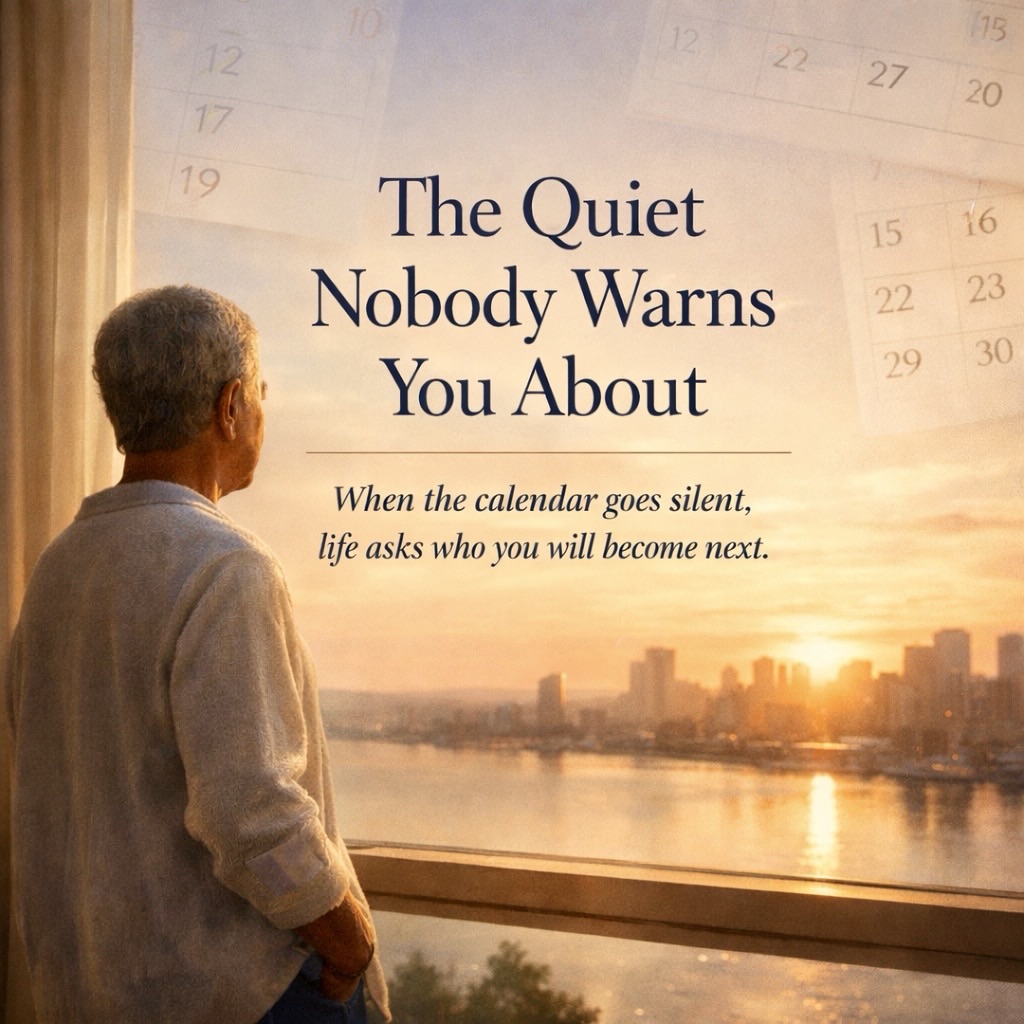
The Quiet Nobody Warns You About
When the Calendar Goes Silent
Many retirees anticipate relief from deadlines, pressure, and workplace stress.
And that relief does come.
But what few anticipate is the quiet that follows.
For decades, work provides a central organizing force. It structures time, directs attention, stimulates the intellect, and offers a clear sense of relevance.
When that organizing force disappears, something surprising can emerge:
a new form of anxiety.
Not the stress of deadlines
but the disorientation of open space.
Without a structure around which to arrange daily life, even freedom can feel unmooring.
This is not a personal failing.
It is a human response to sudden unstructured time.
When Stress Disappears, Anxiety Can Appear
Workplace pressure can be exhausting, yet it also provides:
- mental stimulation
- variety and challenge
- immediate feedback
- daily purpose
When those disappear overnight, the nervous system and mind must recalibrate.
Many retirees describe feeling unexpectedly restless, unfocused, or unsettled.
The absence of stress does not automatically create peace.
Peace requires structure, meaning, and engagement.
Five Things to Do BEFORE You Retire
Purpose Comes First
Ask what energizes you, where you still feel useful, and who benefits from your wisdom.
Build Connection Early
Isolation rarely happens overnight. Begin cultivating relationships and community now.
Design Your Daily Rhythm
Freedom works best when supported by structure and predictable routines.
Keep Your Mind Engaged
Your experience is not obsolete. Continued learning and contribution sustain vitality.
Strengthen Your Body on Purpose
Movement supports longevity, energy, and independence.
The Countdown Clock
12 months out explore interests and build connections.
6 months out expand new roles and rhythms.
3 months out schedule social anchors and structure.
Final month celebrate the past and step forward intentionally.
Ritual matters. Closure matters. Transition deserves acknowledgment.
When You Don’t Have to Navigate This Alone
Retirement is one of the most significant transitions a person will ever experience. It involves identity, purpose, relationships, routines, finances, and emotional adjustment.
Many people assume they should simply figure it out.
But clarity often comes faster through thoughtful conversation.
Working with a coach during this transition can help you:
- clarify what you want this next chapter to look like
- design routines that support wellbeing
- navigate identity shifts with confidence
- prevent isolation and loss of purpose
- stay aligned with what matters most
You do not have to navigate this transition alone.
Sometimes the most powerful step forward is a conversation.
If you would like to explore what this next chapter could look like for you, you are welcome to schedule a time to talk:
https://calendly.com/quackenbushcoaching/30min
Retirement Is Not an Exit. It Is an Evolution.
We are living through an unprecedented demographic shift often called the Silver Tsunami.
But what matters most is not the scale of retirement.
It is the quality of the next chapter.
Some experience a vacuum.
Some experience continuity.
Most experience both.
The question is not:
What are you leaving behind?
The question is:
What are you stepping toward?
And perhaps the deeper question:
Who do you now have permission to become?
Ready to design your next chapter with intention?
 Quackenbush Coaching LLC